
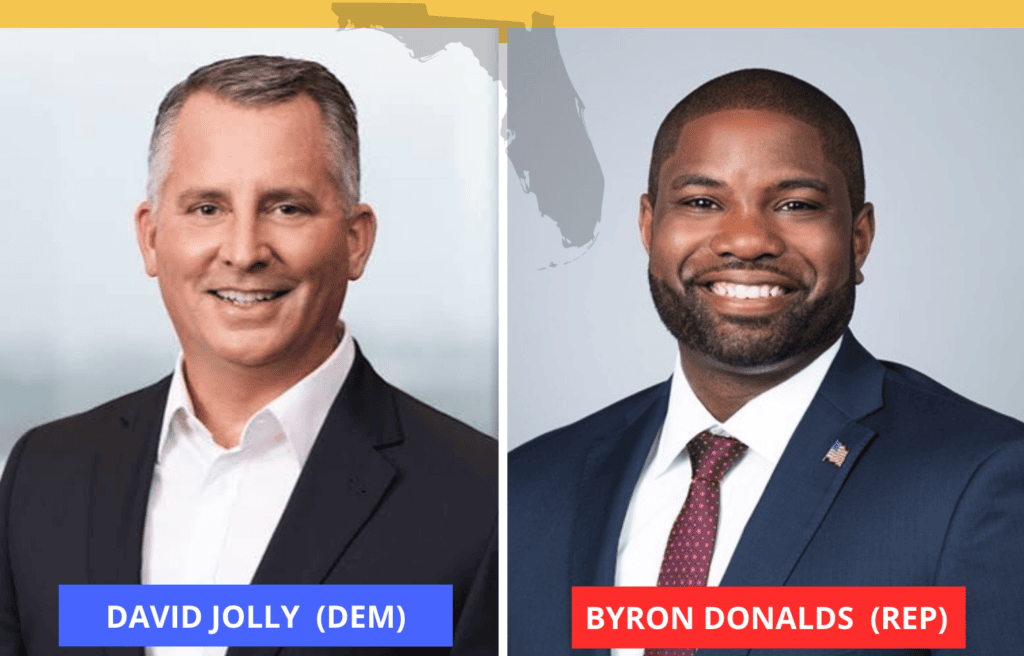
Donalds vs. Jolly: What Comes Next for Florida in November
With Florida’s primary election setting the stage for the race to succeed Gov. Ron DeSantis, Republican Byron Donalds and Democrat David Jolly are poised to move into a general election campaign that will test not only two very different candidates, but also Florida’s changing political landscape.
The November contest brings together two former members of Congress with dramatically different political trajectories.
Donalds, a Republican congressman from Southwest Florida and a prominent ally of President Donald Trump, entered the primary as the clear Republican frontrunner. Jolly, meanwhile, is a former Republican congressman who left the GOP in 2018, joined the Democratic Party in 2025 and is now attempting to lead Democrats back into contention in a state that has moved decisively toward Republicans in recent election cycles.
With the primaries behind them, the larger question is no longer who can win within each party.
It is whether Florida is headed toward another Republican statewide victory — or whether Jolly can assemble a coalition capable of making the governor’s race competitive again.
Donalds begins with significant advantages
Donalds enters the general election from a position of strength.
Florida has undergone a substantial political transformation. Once one of the nation’s premier battleground states, it has increasingly favored Republicans in statewide elections. DeSantis won reelection by nearly 20 percentage points in 2022, and Republicans have expanded their advantage among registered voters.
Donalds will now attempt to capitalize on that environment while consolidating Republican voters after the primary.
He also enters the next phase with another major advantage: money.
Donalds has built a formidable fundraising operation during the campaign. His campaign and affiliated political committee raised more than $111 million ahead of the primary, and he entered the final days with approximately $58 million still available, giving him the ability to immediately invest heavily in advertising, organization and voter outreach across the state.
Jolly faces a substantially different financial reality.
His fundraising has been strong relative to his Democratic primary opponents, but his resources remain far below Donalds’. The disparity means Jolly will likely need a significant influx of Democratic donors and outside support if he is to compete with the Republican nominee’s statewide operation.
That financial imbalance could become one of the defining elements of the general election.
But the race does not begin as a landslide
Despite Florida’s Republican shift and Donalds’ enormous financial advantage, early polling suggests Democrats cannot simply be written out of the race.
Two recent surveys tracked by 270toWin show Donalds ahead of Jolly, but by single digits.
An August James Madison Institute poll placed Donalds at 45% and Jolly at 38%, while a July University of North Florida survey showed Donalds at 46% and Jolly at 41%.
Those numbers give Donalds an early advantage, but they also suggest that a meaningful portion of the electorate remains persuadable.
For Jolly, that is where the opportunity lies.
Jolly is betting on an unconventional coalition
Jolly’s political history makes his candidacy unusual.
He represented a Tampa Bay-area district in Congress as a Republican before breaking with the party during the Trump era. He later became an independent and eventually joined the Democratic Party.
Rather than running solely as a traditional Democratic candidate, Jolly has positioned himself to appeal to Democrats, independents and Republicans dissatisfied with the direction of their former party.
His selection of former U.S. Rep. Gwen Graham as his running mate reinforces that strategy. Graham, daughter of the late Florida Gov. and U.S. Sen. Bob Graham, brings one of the state Democratic Party’s best-known political names to the ticket.
The strategy presents both an opportunity and a challenge.
Jolly must generate enough enthusiasm among Democratic voters while simultaneously convincing independents and moderate Republicans that he represents a viable alternative to Donalds.
In a state where Republicans currently hold the structural advantage, he likely needs all three groups.
Donalds could make Florida history
There is also a historic dimension to Donalds’ candidacy.
If elected in November, Donalds would become Florida’s first African American governor.
His campaign is also likely to keep Florida closely connected to national Republican politics. Trump endorsed Donalds early in the gubernatorial race, and Donalds has emerged as one of his most visible allies in Florida.
That relationship could help energize Republican voters, particularly in a midterm election in which turnout will be critical.
At the same time, it gives Democrats a clear contrast around which to organize their campaign.
The issues that could define November
Once the primary battles fade, the campaign will increasingly turn toward issues affecting Floridians directly.
Housing affordability, homeowners insurance, property taxes, the cost of living, education, immigration and economic growth are likely to play prominent roles.
For Donalds, the argument will largely center on continuing the conservative direction Florida has followed under Republican leadership.
For Jolly, the challenge will be convincing voters that rising costs and other pressures facing Florida families warrant a change in Tallahassee.
South Florida could become particularly important.
Miami-Dade County, once considered a Democratic stronghold, has undergone one of the most striking political transformations in the state. Both campaigns will have reasons to invest heavily in the region, including its large Hispanic electorate and substantial bloc of independent voters.